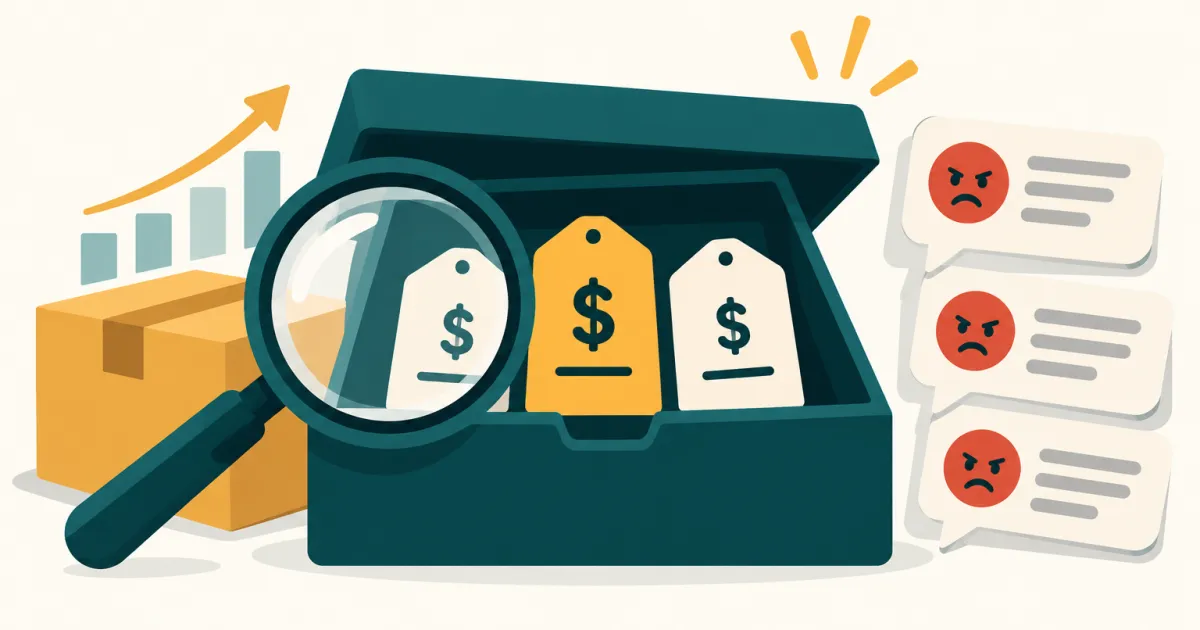
Prelaunch.com is a product-validation platform: you put up a landing page for a product that does not exist yet, drive traffic to it, and measure who is willing to leave a small refundable deposit — a “reservation” — as proof they would actually buy. Our verdict: the reservation-deposit method is a genuinely stronger intent signal than a survey vote, but the platform’s subscription starts at $279 a month, the pricing page is buried where most visitors will never find it, and the public complaint record is dominated by the platform’s own consumers — the people whose deposits make your validation data — which is a risk the marketing site never mentions. All official claims below were checked on prelaunch.com on 2026-08-26; every user quote carries its own date and link.
How this review was produced, plainly: we do not have a Prelaunch.com subscription and have not run a validation campaign through a logged-in account. This is a desk review built from the platform’s official public pages, transcribed on 2026-08-26, plus verified public user reviews quoted verbatim with dates. There are no claims here about what the dashboard feels like to operate. Every check is dated so you can repeat it.
What Prelaunch.com actually sells
Prelaunch.com positions itself as an “All-in-One Platform to Launch Iconic Products,” claiming a “1M+ Community” and “Trusted by 1000+ Brands,” with the tagline “No panels. No code. No complex integrations” (homepage, checked 2026-08-26). That “no panels” line is a direct jab at polling services such as PickFu, which recruit paid respondents — we cover that model separately in our PickFu review .
The product menu on 2026-08-26 lists four testing use cases — concept testing, price testing, branding and marketing testing, and business model testing — plus post-reservation surveys and a set of AI interviewer agents (voice, video, and WhatsApp chat) that the navigation flags as “NEW.” The core mechanic behind all of it is the reservation funnel: instead of asking people whether they would buy, the platform asks them to put a small deposit down. The homepage demo cards all show a “Reserve for $5” button (checked 2026-08-26).
Less obvious from the marketing copy: Prelaunch.com is two-sided. Alongside the creator tooling there is a public “Explore Products” marketplace where consumers browse live project pages and leave reservations — the site’s own sitemap lists dozens of live /projects/ pages, from AI health rings to pet furniture (checked 2026-08-26). That community is what the “1M+” figure refers to, and it matters for the review record below, because it means the company has obligations to two audiences: the brands who pay subscriptions and the consumers who pay deposits.
The output for creators is a per-product dashboard the homepage previews with a “Prelaunch Score,” concept-validation and price-validation panels, use-case breakdowns, and AI-generated customer personas you can chat with. We have not operated this dashboard, so we make no claim about how reliable those scores are in practice. Worth noting for budget planning: the primary call to action across the site is “Book a Demo,” not a self-serve signup — the sales motion, like the price points, is aimed at funded brands rather than side-project founders.
Pricing: published, but you have to know where to look
The interesting thing about Prelaunch.com’s pricing is not the numbers — it is how hard the company makes them to find. On 2026-08-26 we tested the obvious URLs: prelaunch.com/pricing and prelaunch.com/plans both return HTTP 200 but serve the homepage itself — same document, same title — so a visitor who types the natural address gets marketing, not prices. The real page lives at prelaunch.com/pricing.html, reachable through a footer link, and it is absent from the site’s own sitemap_1.xml (0 matches for “pricing,” checked 2026-08-26). Search engines and AI answer engines summarizing this platform routinely report its pricing as undisclosed; as of 2026-08-26 it is disclosed — just buried.
Here is the pricing page transcribed on 2026-08-26. The page shows a monthly/annual toggle; both figures are per month, and both are listed below because the discount badges do not always match the arithmetic.
| Plan | Monthly billing | Annual billing (per month) | Badge on page | Computed discount |
|---|---|---|---|---|
| Starter — “Ideal for initial validation” | $279 | $250 | −10% | ~10.4% |
| Pro — “Perfect for in depth validation” | $789 | $658 | −20% | ~16.6% |
| Ultimate — for “large scale validation” | $1,399 | $1,166 | −17% | ~16.7% |
The Pro badge says −20%, but $658 against $789 works out to roughly 16.6% off — as printed on 2026-08-26. Read the numbers, not the badges.
What the tiers gate, per the same page: Starter collects up to 3,000 subscribers and includes analytics, post-reservation audience insights, and support through a Slack community. Pro adds a concierge service for one product, up to 15,000 subscribers, three products tested at once, unlimited test iterations, product-option testing, price A/B testing, up to 3 collaborators, and one inclusion in the company newsletter — which the page describes as reaching a “100k-strong prelaunch.com community,” a number worth setting beside the homepage’s “1M+ Community” claim; both figures appear on the same site on the same day. Ultimate adds a concierge for two products, seven products at a time, up to 10 collaborators, and two newsletter inclusions — yet its subscriber line reads “Collect up to 15K subscribers,” the same cap printed for Pro (as shown 2026-08-26; whether that is a copy error or the real limit, confirm before paying the difference).
There is also a free entry point: “You can try our product with limited functionality for free (no credit card required)” (pricing page, 2026-08-26). The page does not specify what the free tier includes.
One cost the pricing page does not mention at all: traffic. The reservation funnel measures the visitors you send to it. A 3-star Trustpilot reviewer quoted below describes a managed ad campaign on Meta and Instagram — ad spend is a separate budget on top of the subscription, and no official page we checked publishes typical campaign costs.
The $5 reservation: why the method is stronger than a poll
To be fair to the method before we get to the complaints: a refundable deposit is the closest thing to purchase data you can get for a product that does not exist. A survey respondent voting for your concept costs them nothing; an email address on a waitlist costs them ten seconds; a visitor handing over $5 has passed a real willingness-to-pay threshold. The conversion rate from visitor to depositor is a materially harder number than the click-through rates that fake-door tests produce, and the post-reservation surveys the platform runs mean every depositor can also be interviewed — that is the coherent part of the product design. Prelaunch’s own resource pages frame the reservation deposit as the “core prelaunch methodology” (help-center navigation, checked 2026-08-26). For founders deciding between this and stated-preference polling, that distinction is genuine — polls measure opinions, deposits measure behavior. If your question is narrower — which main image or which title wins — a poll is cheaper and faster, and our PickFu alternatives roundup covers that category.
Note the deposit amount is not fixed by any official page we found: the homepage demos show $5, while one Trustpilot reviewer below reports paying $10 for a reservation. We found no official page stating who sets the amount.
What users actually complain about
Here is the part the case studies do not cover. Prelaunch.com’s public Trustpilot record is dominated not by the brands who subscribe, but by the consumers who left deposits — and their complaints cluster around two themes: refunds and silence. For context, the aggregate record is not one-sided: as of 2026-08-26 the company’s Trustpilot profile shows a TrustScore of 4.2 out of 5 (“Great”) across 50 reviews, with 72% five-star and 12% one-star ratings. The complaints below are the recurring minority themes — quoted for what they reveal about how deposits are handled when projects stall, not as the majority verdict. All quotes below are verbatim from Trustpilot, with the reviewer’s rating and date.
Theme 1: refund disputes over what “launch” means. The refund promise is that deposits are refundable until launch — and two reviewers who backed the same electric motorcycle discovered that “launch” meant something different from what they assumed. A 1-star reviewer (2024-03-18 ) wrote: “It seems that prelaunch consider launch as the start of the funding cycle to keep the project afloat. No one has any idea when the bike will officially start production which in my mind means that it hasn’t launched yet.” Another 1-star reviewer of the same product (2023-08-04 ) put a deposit on a “$10000” motorcycle and reported: “It was clearly stated that the deposit was refundable until the launch of the product… Both prelaunch and Fuell have refused to refund my deposit.”
Theme 2: the platform’s role when projects fail. A 1-star reviewer (2023-09-12) wrote: “Prelaunch states they will have the control over deposits and give back they money if project does not comply. They dont give my money back and say it is in hands of the launching company” [sic]. Another (2025-11-11 ): “Buyer beware. Lost investment and prelaunch makes their piece but does nothing to protect you” [sic]. A third (2026-07-07) wrote: “Another Kickstarter-related scam company that swindles people out of money without being able to offer any guarantees.” And a reviewer who reserved a pizza oven (2026-01-08 ) reported: “Get charged $10 Prelaunch.com receipt… for an oven reservation and in the end get nothing. When I asked what was going on, I didn’t get any reply.”
The creator side is quieter — and mixed. The one substantive creator review we found is a 3-star from 2024-04-27, describing a managed campaign: “I had to go through 5 different people because each one was responsible for their respective area of expertise… The response time was somewhat slow. Would have wished they adjusted the campaign earlier instead of simply waiting for almost running out of budget to do it.” That is not a scam complaint — it is an ordinary agency-service complaint about handoffs and slow optimization, and worth weighing against the concierge service Pro and Ultimate charge for.
Why should a subscribing brand care about consumer-side complaints? Because the consumers are the product. Your validation data comes from real people trusting the platform with deposits; a platform whose backers publicly describe refund fights and unanswered emails is spending down the very trust your campaign depends on. If your test audience arrives already suspicious, your reservation rate measures their suspicion as much as your concept.
Does this fit an Amazon seller’s workflow?
Prelaunch.com is not an Amazon tool. It validates products before a listing exists, on your own funnel, with your own traffic — closer in spirit to a crowdfunding pre-campaign than to anything in Seller Central; if that is your world, see our roundup of Kickstarter alternatives . For an Amazon-first seller, the honest fit assessment looks like this:
- Good fit: you are developing an original product with real tooling costs, you plan a D2C or crowdfunding launch before (or alongside) Amazon, and a failed launch would cost you five figures. At $279–$789 a month plus ad spend, one or two months of validation is cheap insurance against a bad mold.
- Poor fit: you sell wholesale, arbitrage, or private-label variations of proven categories. Your validation already exists — it is the sales history of competing ASINs, and tools that read that history cost a fraction of a Prelaunch subscription.
- Middle ground: you have a differentiated private-label concept and want willingness-to-pay data before committing inventory. The free tier plus a small ad budget is a rational first step; just price in the traffic you will have to buy, because the platform measures visitors, it does not supply them at Starter level.
One more planning note: the price-testing use case overlaps with what you can do natively once a listing exists — Amazon’s own experiments, review-driven iteration, or a cheap stated-preference poll. Prelaunch.com’s window of usefulness is specifically the period before you have an ASIN and inventory; once you are live, the platform’s core signal (deposits from your own funnel traffic) is replaced by better data Amazon gives you for free.
Verdict: worth a demo, not a blind subscription
The methodology is the strongest part of Prelaunch.com: deposits beat survey votes as evidence, and the tooling around the funnel — price A/B tests, post-reservation surveys, AI interviewers — is a coherent package (all per official pages, 2026-08-26; not independently tested by us). The weakest parts are transparency and trust: a pricing page hidden behind a footer link and missing from the sitemap, discount badges that do not match their own arithmetic, a subscriber cap printed identically on two differently priced tiers, and a public review record where the loudest voices are consumers describing refund disputes.
If you go forward: start on the free tier, confirm the current numbers on prelaunch.com/pricing.html yourself — every figure here is a 2026-08-26 snapshot — and ask the sales team directly how reservation refunds are handled when a project stalls, because that answer determines what your backers will say about you on Trustpilot later.
All pricing and feature data checked on prelaunch.com on 2026-08-26. User quotes are verbatim from Trustpilot with original dates. Confirm current terms with the vendor before purchasing.
Disclosure: amzfinder has no affiliate relationship with Prelaunch.com and this review contains no Prelaunch.com affiliate links. We do not accept paid placement or sponsored reviews. This assessment reflects official public pages and dated public reviews, not a live paid account. Last updated: August 2026.